The Luthier’s Blog

Welcome to Lehmann Guitars! I have been making unique stringed instruments based on reliable and true models since 1971. This is my blog about wood, tone, set ups and other questions you have about fine stringed instruments. Check out my Web site, www.lehmannstrings.com, for custom models.

Saturday, May 17, 2008

A fresh start!

Well, I haven't been heard from around here for quite some time so I decided to get back to posting regularly. I'm planning on making a few format changes and rededicating myself to making this blog a regular and interesting forum. Anyway, for now you are going to have to be satisfied with this:


video

Labels: , , ,

Wednesday, May 10, 2006

Rebec!

Today Bernie started work on a couple of brand new Rebecs! Rebecs are cool, pear-shaped, violin-like instruments that were the hottest thing in the medieval dance halls.

(photo courtsey lehmannstrings.com medieval photo archive)

Bernie is combining his characteristic modern technical eclat and traditional artistic elan to build the hottest rebecs to hit the stage in centuries! Despite recent editorial laxity, I do hope to have further info and pics about Bernie's latest instruments soon. For now, click here to check out the Vielle & Rebec page at lehmannstrings.com to see photos of some of Bernie's Rebecs and other medieval instruments.

If you are interested in more info on the 'electric guitar of the castle's great hall' the Wikipedia entry is as good a place to start as any.

Wednesday, March 22, 2006

The Traveling Gypsy

Check it out! Bernie has finished a new guitar! This time it's a collapsible gypsy guitar that fits neatly inside a small suitcase. I hope to have a post in the next few days in which I can share with you what Bernie has to say about #399, the Lehmann Gypsy Caravan. In the mean time, check out the photos of his latest in Headstock News on the website.

Friday, February 17, 2006

Cocobolo


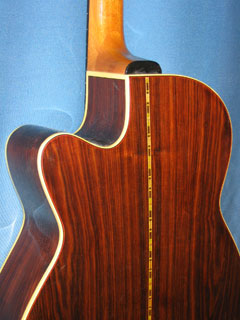
Well, Bernie's fininshed another instrument. This time it's a flattop. Number 398. As you can see from the photos, it has a cutaway and features Bernie's unique pierced headstock. I think these two features just look awesome together.

The top is wide-grained Adirondak spruce to give the instrument warmth and a lively tone. The sides and back (which you can see in the other photos) are Cocobolo. This is in the same family as Brazilian rosewood. The cocobolo used in this guitar is very dense and strong. With such a dense material Bernie was able to make it thinner than normal while still retaining the vibrance and volume of sound in the guitar. All this with looks too! Just take a look at that back - remarkable!

Bernie says he's pretty happy with how the instrument came out. "The tone is really the thing here. That's my first priority and why I'm so pleased with this guitar. What good is a great looking guitar if nobody wants to play it? (That said, have you seen the back?)"

With the cutaway and his special side sound port I don't think Bernie has much to worry about - this is clearly a player's instrument.

Well, I'll close with one more pic of Bernie's latest, but not before I recommend checking this space again soon to see what Bernie has up his sleeve next!


Friday, January 27, 2006

Guitar Building Primer

So what does a master luthier do with his time? I asked Bernie recently and he was so enthusiastic about having just finished a brand new custom Model 1887 flattop (No. 398) that our conversation ended up being a sort of a primer on basic guitar making. As I said in a previous post, it takes Bernie about a month to build a new flattop guitar and when we spoke he had just the previous day completed a guitar – so this is essentially what he has been doing so far this year.

In an extremely abbreviated and cursory way, here is a look at the process of building a hand made custom flattop guitar.

After consulting with the customer about what they are looking for in the instrument the first time Bernie puts tools to wood is to begin shaping and thickness-ing the top and back. In his most recent guitar this meant making a spruce top with a cut-away and a cocobolo back. Cocobolo is a tropical wood similar to rosewood. (I plan on asking Bernie to tell me more about woods for a later post.) The top of a flattop is (you guessed it) flat, but the back is arched, so after it is carved down to the exact right thickness Bernie clamps it into a special mold and glues on the bracing. (Expect more on bracing later too.) Braces then go on the top too.

While this is all setting up, Bernie then makes the sides of the guitar – in this case out of cocobolo once again. After thinning them to the proper dimensions and trimming them to the proper width to match the curve of the back, he applies heat, steam and pressure to get them to fit the shape of the guitar. He then glues in the neck and the tail blocks, attaching the two halves. Then he cuts his unique sound port into the side and adds a binding to reinforce that.

Next, the luthier attaches kerfed binding strips to the inside of the sides and glues on the top, then the back. Always in that order because the top on a flattop is, yes, flat, and therefore it makes it more stable to set down when attaching the back. Next come the bindings that encircle the top and the back on the outside edge of the guitar. In the case of the newly finished Model 1887 No. 398, Bernie used his standard multi-laminate plastic body bindings. In order to put these in place he does the final shaping of the top and the back by cutting the edges just so, leaving the exact amount of under-hang, if you will, so that the binding fills it up perfectly ensuring a precisely smooth edge.

The neck is Bernie’s next order of business. Usually grafted together from two or more pieces of wood, he cuts it into a rough, squared-off version of the final product. He then cuts the dovetail joint that perfectly matches up with the neck block so that it tightens up and holds itself into place when pressed in from the top of the guitar. The heel and the headstock are then carved into their near-final shape while the back of the neck is left squared-off. Scratching, shaving, and sanding, he fits the tight neck joint in so that it squeezes into place at the precise angle needed to carry the tension of the strings and still keep the strings at an exact distance from the fingerboard. Speaking of which, that’s the next addition. Using the flat back of the neck, Bernie clamps and glues on the fingerboard in which he has mounted the frets and, in this case, inlayed pearl position dots. Only when this is set does Bernie carve the back of the neck.

Next, all the little details that really make a Lehmann stand out. Decorative soundhole rings, heel carving, unique headstock details; in short all the little extras are added. The list of these features is endless and, as noted in the previous post, can add weeks to the project. Model 1887 No. 398 includes a fancy soundhole ring and engraved inlays.

Bernie’s top-secret finishing process is next. He could say more about it, but then he’d have to kill ya. All we really know is that it takes many coats and days of sanding and polishing to get a guitar to look as good as does a Lehmann. This process is closely guarded for good reason: the finish on a guitar is not just for good looks, it also is the guitar’s main defense shield against you abusive strummers. The interaction of the finish with the wood also has an impact on the final sound of the instrument. The way it soaks into the wood can really change how the wood reacts to the vibration of the strings and therefore how it projects sound.

After the finish is applied and dried the bridge is attached along with the nut and the tuning machines. That’s when the guitar finally gets to be strung up for the first time. The guitar then needs a few days to settle into the tension of the strings, letting the joints get used to the pressure. Bernie sets up the guitar and hears its first words – I mean notes, then comes back to it over the next few days to re-tune and tinker before the customer comes back for the final setup and delivery.

Model 1887 No. 398 is sitting at Bernie’s shop as I write this, getting used to the tension of its first set of strings. Cool.

Monday, January 23, 2006

Start to Finish

Hi, I'm Matt and I'm going to start writing some posts in this place based upon some interviews with Bernie. I wouldn't rely on anything too regular here but it has to be better than the frequency of posts so far! I'm far from being an expert on the craft of lutherie so I'm looking forward to learning about what Bernie does on a day to day basis too. Feel free to post comments with questions you would like me to ask Bernie or anything about the blog, the website, Lehmann guitars, or whatever.

So, the first topic that occurred to me is to ask about how long it takes to make a guitar. Bernie makes his guitars from scratch - starting with rectangular hunks of lumber and shaping, carving, gluing, etc. until he has an instrument. He builds each instrument by hand and to the specifications of the buyer so the time it takes can vary considerably based on the type of guitar, the amount of custom detail work, and even the weather.

The first thing Bernie does when building a guitar is to sit down with the customer and have a discussion about what he or she is looking for in a guitar. This can be accomplished fairly quickly if the customer knows exactly what he wants while some customers have been known to take months of looking at photos, trying other Lehmann guitars, and talking with Bernie to nail down the precise type of guitar, features, details, and extras. With this information the luthier is ready to make some wood chips.

To build one of his flattop or gypsy style guitars it takes him about two weeks worth of work, or about 80-100 hours. He says this time is usually spread over at least a month because the process includes some inevitable down-time for things like waiting for glue to dry or waiting for a layer of finish to set up. This includes everything from the initial shaping of the wood to stringing up the finished product. Additional detail and ornamentation work, like you can see in abundance on his new Model 1887 Deluxe, with all its engraved inlay, can add an additional 30-40 hours. That means the guitar featured on his website under Headstock News took Bernie around 130 hours, or three weeks worth of work to hand build!

Bernie's arch top guitars take even longer than the standard flattop. He estimates that they take about an additional week worth of work, for a total of between 130-150 hours! Most of this extra time is because he has to carve out the top to a precise curve and with exact thicknesses. Also, he makes an ebony tailpiece for each arch top that requires considerably more work than the flattop's bridge.

The others pall in comparison to the Model 2000 however. It can take between four and five weeks of work, or between 160-200 hours! As Bernie says "it's just loaded with details and all those take a lot of time." The back, the sides, everything takes additional time with the Model 2000 - it comes with all the bells and whistles. You get every imaginable detail, all the trimmings with the Model 2000 and they all take time.

Well, that's it for now. Add your comments and look here for more from Bernie soon!

Tuesday, October 25, 2005

Lehmann Guitar Fest

The second Lehmann Guitar Fest was a great success. Thanks to all who attended, and to all the musicians who performed. The Artisan Works Gallery is truly a unique place and provided an interesting and creative environment for all to enjoy the music. The fourteen performers and groups provided a fine variety of styles that showcased the versatility of the guitar and the individuality of the musicians. Apologies about the house sound system. Glen Drinkwater did a fabulous job under fire to save the show. Thanks! Check for a photo link in "Headstock News".

free web stats